

Measurements
Thorough characterization of solar cells requires the investigation of various processes that occur at different timescales. The FastChar tool offers 9 well-established and emerging characterization techniques. Check the list below to learn more about the information these measurements provide.
Fast JV

Prebias JV
CELIV

BACE

Current decay

Double injection

Capacitance

Mott-Schottky

SCLC

Fast Hysteresis

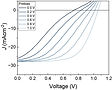
Fast JV characterization (dubbed "fast-hysteresis") is the core measurement. It allows for determining the contribution of ionic losses to each performance metric (PCE, Jsc, Voc, and FF) and degradation losses. This is done by measuring the JV over a wide range in scan speed (0.001 - 1000 V/s) after a certain prebias. The fast hysteresis PCE plot reveals 3 key features: 1) the steady-state PCE, 2) the peak hysteresis, which is related to the ion transit time, and 3) the ion-freeze regime (see publications).
Special features
-
Reproduce Keithely SMU at slow scan speeds
-
Extend scan range from (0.001 - 1000 V/s)
-
Variable prebias
Fast Hysteresis
Fast JV characterization (dubbed "fast-hysteresis") is the core measurement. It allows for determining the contribution of ionic losses to each performance metric (PCE, Jsc, Voc, and FF) and degradation losses. This is done by measuring the JV over a wide range in scan speed (0.001 - 1000 V/s) after a certain prebias. The fast hysteresis PCE plot reveals 3 key features: 1) the steady-state PCE, 2) the peak hysteresis, which is related to the ion transit time, and 3) the ion-freeze regime (see publications).
Special features
-
Reproduce Keithely SMU at slow scan speeds
-
Extend scan range from (0.001 - 1000 V/s)
-
Variable prebias
Prebias JV

To to probe ion accumulation at the interfaces, freely vary the prebias at fast scan speeds.
Special features
-
Variable prebias and frequency
CELIV


Charge extraction by linearly increasing voltage (CELIV) is a powerful technique to determine the doping concentration in organic semiconductors. For perovskites, it can also be used to analyze the mobile ion concentration at longer timescales (ms to s).
BACE


Bias assisted charge extraction (BACE) can be used to determine the concentration of free charges in the solar cell, such as photogenerated, injected and electrode (capacitive) charges, as well as the mobile ion density at longer timescale (ms to s). The code directly calculates the extracted charge. In degraded samples the ion density is typically very large which correlates strongly with device stability (>1E18 cm-3). To assess these charge carrier densities, it is important to measure to low currents at long timescales (e.g. 1E-6 mAcm-2)
Current decay


Mobile ions affect the short-circuit current of the device in steady-state as a result of internal field screening. The ionic Jsc loss can easily exceed 10 mAcm-2 in degraded devices. The current loss dynamics can be investigated by measuring the scan-rate-dependent JV or the current transient after a switch from Voc to 0V. Similar to the current decay, the ionic PCE loss can be analyzed in a transient mode by measuring the decay of the stabilized power output (SPO) as a function of time. Hence, this measurement is dubbed "SPO decay".
Double injection

Double injection (DI) is the opposite of BACE, i.e., the injection current is measured after a switch of voltage from 0V to forward bias. After this switch, mobile ions are pushed back into the active layer or to the other electrode. The turn-on time observed in the DI transient is related to the effective ion speed, which can be compared with the ion-drift time observed in BACE or the peak hysteresis. This measurement also provides us with clues about the total mobile ion density and dynamics.
Capacitance


Impedance and capacitance-based measurement techniques are powerful tools to investigate electronic devices. While commercial impedance analyzers are often optimized for high frequencies, they struggle with accurate measurements at low frequencies (< 1Hz). This is the critical regime where mobile ions play a role. Our setup allows to measure the capacitance down to 10 mHz, therefore providing another complementary approach to study the ion density (see publication 2).
Special features
-
Measure capacitance in the 10-100 mHz range to determine mobile ion density and kinetics
Mott-Schottky

The Mott-Schottky (MS) analysis is a common method to determine the doping density and the built-in field from the characteristic slope in various solar cells. However, in the case of an intrinsic device, the MS plot does not display a characteristic slope around 0 V, but rather an exponential behavior at Voc due to injected electronic charges. However, low-frequency MS analysis reveals the characteristic slope, allowing us to study the ion density (see publication 2).
Special features
-
Perform high- and low-f MS analysis to determine the mobile ion density
SCLC

Space charge limited current (SCLC) measurements are commonly used to determine the mobility and the density of trapped charge carriers under specific conditions. The FastChar setup allows the analysis of these properties under "ion-freeze conditions" at fast-scan speeds.